
Most routes through northern Portugal are drawn the same way. Land in Porto, spend a night or two by the river, then head east into the Douro Valley, where the terraced hills are. On paper the city is the arrival point and the valley is the prize.
That reading gets the history backwards, and it costs the traveler a good deal. The valley grew the grapes, but the city built the trade that made the wine famous. The order you take them in decides which of those two stories you can see.
This essay looks at the Porto to Douro route as a problem of sequence. Why city first works. What the move between them should feel like. And what changes when the route is reversed or rushed.
Two places, one system
It helps to see the region as one machine with two halves.
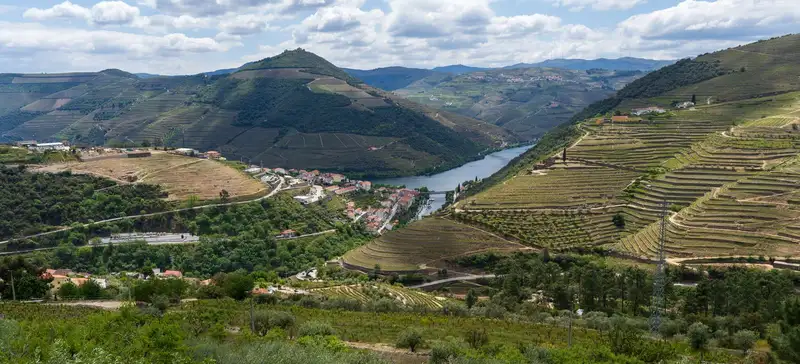
The upper half is the valley. It is steep, hot in summer, and built from schist, a flaky stone that splits into layers. For centuries people cut it into terraces and held them up with dry stone walls so vines could grow on slopes too steep to plow. UNESCO listed the Alto Douro Wine Region as a World Heritage Site in 2001. It names nearly two thousand years of winemaking and the terraces, quintas (wine estates), villages, chapels and roads shaped by that work. You can read the listing on the World Heritage Centre page.
The lower half is the mouth of the river. Porto sits on the north bank. Vila Nova de Gaia sits on the south bank, facing it. For most of Port's history, this is where the wine came to be aged, blended, sold and shipped. Wine traveled down the river in barrels on flat wooden boats called rabelos. In Gaia it waited in long, dark lodges. Then it went out to sea. Until 1986, Port could only be exported from Gaia. That rule is the reason the big names still keep their cellars there.
The trade had a political shape too. The Methuen Treaty of 1703 cut the duty on Portuguese wine entering England, and English merchants built much of the Port business. In 1756, under the Marquis of Pombal, the crown created a company to control Douro wine and marked out where Port could come from. It was one of the first wine regions in the world to have its borders drawn by law. The company was run from the city, not the vineyards.
So the two halves are not "city" and "nature." They are the market and the farm. Each makes sense of the other.
Why the city should come first
The lodges explain the hills
A route that starts in Porto lets you meet the finished product before the place it came from. In a Gaia lodge you see barrels stacked in rows, smell old wood and wine in cool air, and hear how the styles are made: ruby, tawny, vintage, white. You learn that Port is wine stopped mid-fermentation by adding grape spirit, which keeps some of the sugar and raises the strength.
None of that is visible in a vineyard. A terrace in September looks like grapes on vines. Once you know what those grapes are headed for, and how far they will travel, the hills read differently. The walls stop being scenery. They become the top of a supply chain that ends in a London dining room or a New York bar.
Reverse the order and the logic flips. You see the hills first, as a view. Then the lodges come at the end, as a shop.
The noise sets up the quiet
There is a second, simpler reason. Porto is a dense city. It climbs steep hills from the river, with trams, markets, tiled churches and narrow lanes. The pace of lunch in a small, crowded tasca at midday is its own lesson in how the north eats, which livedbylocals.com looks at in its piece on the Portuguese tasca at lunchtime.
The valley is the opposite. Small towns, long gaps between them, the river wide and slow, hardly a sound at midday. If you arrive in that quiet straight off a plane, it is pleasant. If you arrive after days of city noise, it lands as relief. Contrast is a design tool, and it only works in one direction. The quiet place has to come second.
The city is easier on a tired traveler
The last reason is practical. Most people reach the region on a long flight. A city forgives jet lag. You can walk a few blocks, eat early, sleep badly and still get plenty out of the next day. A valley built around booked tastings, long drives and set lunches does not forgive it as well. Putting the demanding half second gives the body time to land.
The move between them is part of the route
The step from city to valley is often treated as dead time. It shouldn't be.
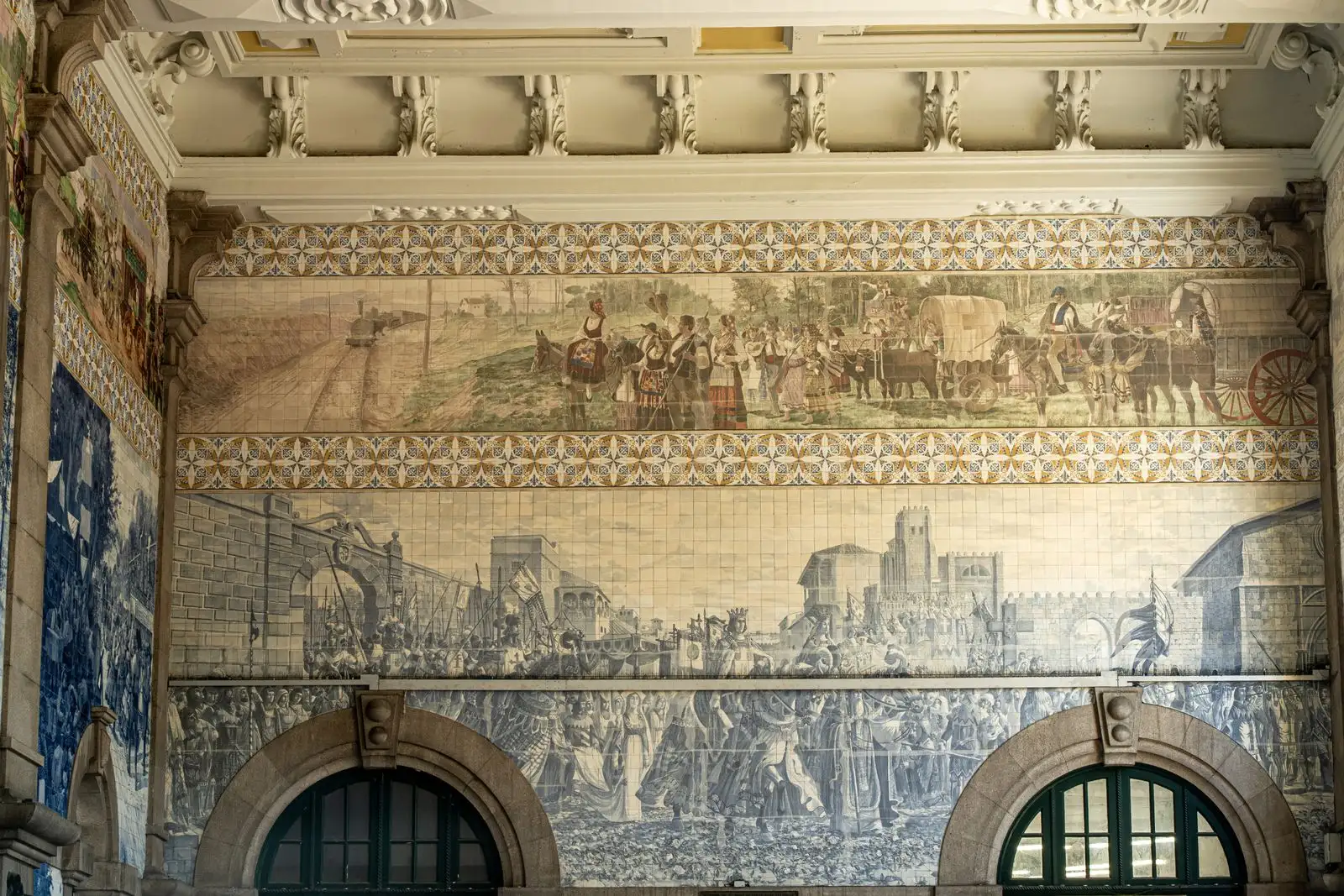
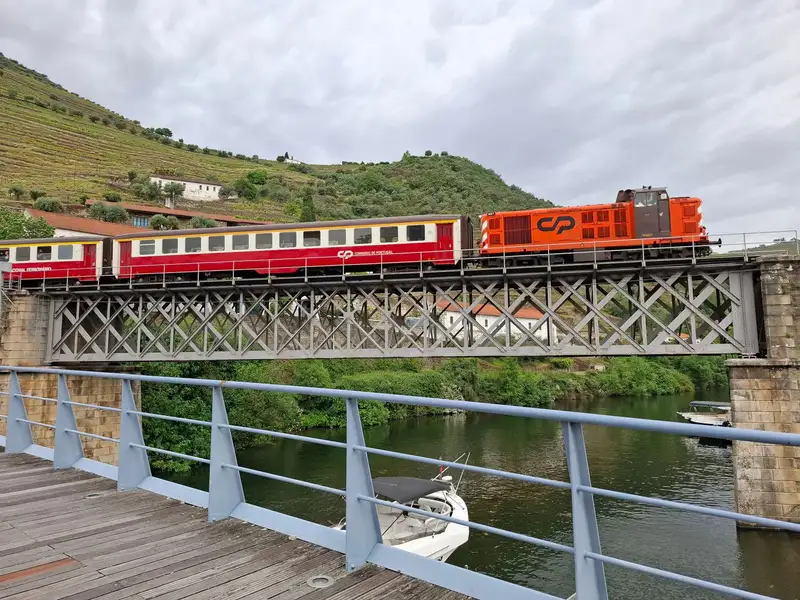
There are three main ways to make it. Road is fastest, about an hour and a half to the start of the valley. A boat from Porto is slowest, working upriver through the locks of the dams. The train sits in between. The Douro line was built in stages from 1875 and reached the Spanish border by 1887. It leaves from Porto's São Bento station, whose hall is covered with about twenty thousand blue and white tiles showing scenes from Portugal's past.
The train matters for sequence because of how it reveals the valley. For the first stretch out of Porto, the land is green and mixed, with small fields and woods. The river is not yet in view. As the line moves east, the hills rise and steepen. Past Régua it runs close beside the water. The schist starts to show. Then the terraces build up the far bank, shelf on shelf, until whole hillsides are vines.
That slow change does what a good overture does. It gives you the main theme in pieces before the full statement. By the time the line reaches Pinhão, the eye has learned how to read what it is seeing.
A car can do much the same, if the driver leaves the motorway and follows the river road east of Régua. A boat does it too, though more slowly. A transfer van on a motorway does not. It drops you in the middle of the scene without the build.
How the valley itself is ordered
The Douro is usually split into three parts, and they have their own sequence.
The Baixo Corgo, around Peso da Régua, is the western end. It is closest to Porto, gets the most rain, and is the greenest. The Cima Corgo, centered on Pinhão, is the classic heart of Port country, with the steep, famous terraces. The Douro Superior runs east to the Spanish border. It is hotter, drier and more remote, with wilder country.
Going west to east follows the train line and the history. You move from the parts closest to the old trade toward the frontier. It also follows a change in feel, from farm country to land close to wilderness.
Most visits do not go past the Cima Corgo, and that is fine. But a longer trip that pushes into the Douro Superior gains a real ending. The landscape grows harder and emptier. You come to understand why the terraces near Pinhão took so much labor, because you have seen what the land looks like further on.
The terraces as a timeline
A route can also be read in time as well as space. The Douro walls are not all the same age, and you can learn to see the difference.
The oldest kind are narrow terraces held up by hand-built schist walls, sometimes with only one or two rows of vines on each step. Many were abandoned after phylloxera, a vine pest that struck the region in the second half of the nineteenth century. Some of those old walls still stand on the hillsides, wild and overgrown. UNESCO notes that the long, regular lines of terraces seen today mostly date from the rebuilding that came after, at the end of the nineteenth century and the start of the twentieth.
Later, from about the 1970s, growers began to cut wider terraces with machines, banked with earth instead of stone. Some slopes are now planted in vertical rows that run straight up the hill instead of along it.
Once you know these layers, a single view from a road above the river holds more than a century of decisions. That kind of seeing takes time. It is one more reason the valley belongs after the city, at a slower pace, not squeezed into a single day.
What gets lost when the route is reversed
Sometimes flights or bookings force the valley first and the city last. It still works, but the losses are worth naming.
The first loss is context. You meet the vines before you know what they make. Tastings in the valley become about taste alone, without the trade behind them.
The second is the arc of energy. Days of quiet followed by a busy city at the end tend to feel like a step down. People often describe the return to Porto in that order as noisy or tiring, where the same streets on day one would have felt exciting.
The third is the reveal. Coming down the valley toward the coast, the terraces thin out and the green returns. It is pretty, but it reads as leaving, not arriving.
If the reverse order cannot be avoided, there are ways to soften it. Start with a short look at the river mouth before heading inland. Save the Gaia lodges for the end, so they close the story instead of opening it. Choose a calmer part of Porto, near the ocean, for the last nights.
What gets lost when the route is rushed
The more common problem is speed. A popular plan gives Porto one night and the valley one long day trip, then moves on to Lisbon.
That plan sees both halves but connects neither. There is no time to absorb the city before leaving it, and the valley day is mostly road. It is also hard to time the light. The terraces are at their best early and late, when the sun is low and the walls throw shadows. A day trip is usually driving back by then.
For people planning the practical side, the tradeoffs between a day trip and a night in the valley are broken down step by step in this guide to planning Porto and the Douro Valley.
A rough shape that respects the sequence
None of this needs a long trip. A week works well.
| Days | Place | What the sequence is doing |
|---|---|---|
| 1 to 3 | Porto and Gaia | Learn the trade, the city's pace and the finished wine |
| 4 | Train or river road east | Let the valley reveal itself in stages |
| 5 to 6 | Cima Corgo, around Pinhão | See the terraces at slow pace, in low light |
| 7 | Back to Porto or on | Leave with both halves in hand |
A shorter trip can keep the shape by cutting days rather than steps. Two days in the city, one night in the valley, and a slow train in between still keeps the order intact.
A longer trip can add the Douro Superior in the east, or the green Minho region north of Porto, home to Vinho Verde. Each of these extends the story without breaking the sequence.
How sequence shapes meaning
Order does not change what a place is. The terraces, the lodges and the river all stay where they are, whatever way you come.
What order changes is what each place is able to tell you. Seen after the city, the valley is the source of something you already know. Seen before it, the valley is a view, and the city is a shop at the end. Both are true. Only one of them lets the region explain itself.
That may be the most useful idea in route design. A place is never met alone. It is always met after something else, and that earlier thing quietly sets the terms. In northern Portugal, the river has already made the choice. The wine has always gone downstream. The traveler who goes up it, from market to farm, is reading the story in the order it was written.

Comments (0)
No comments yet. Be the first!