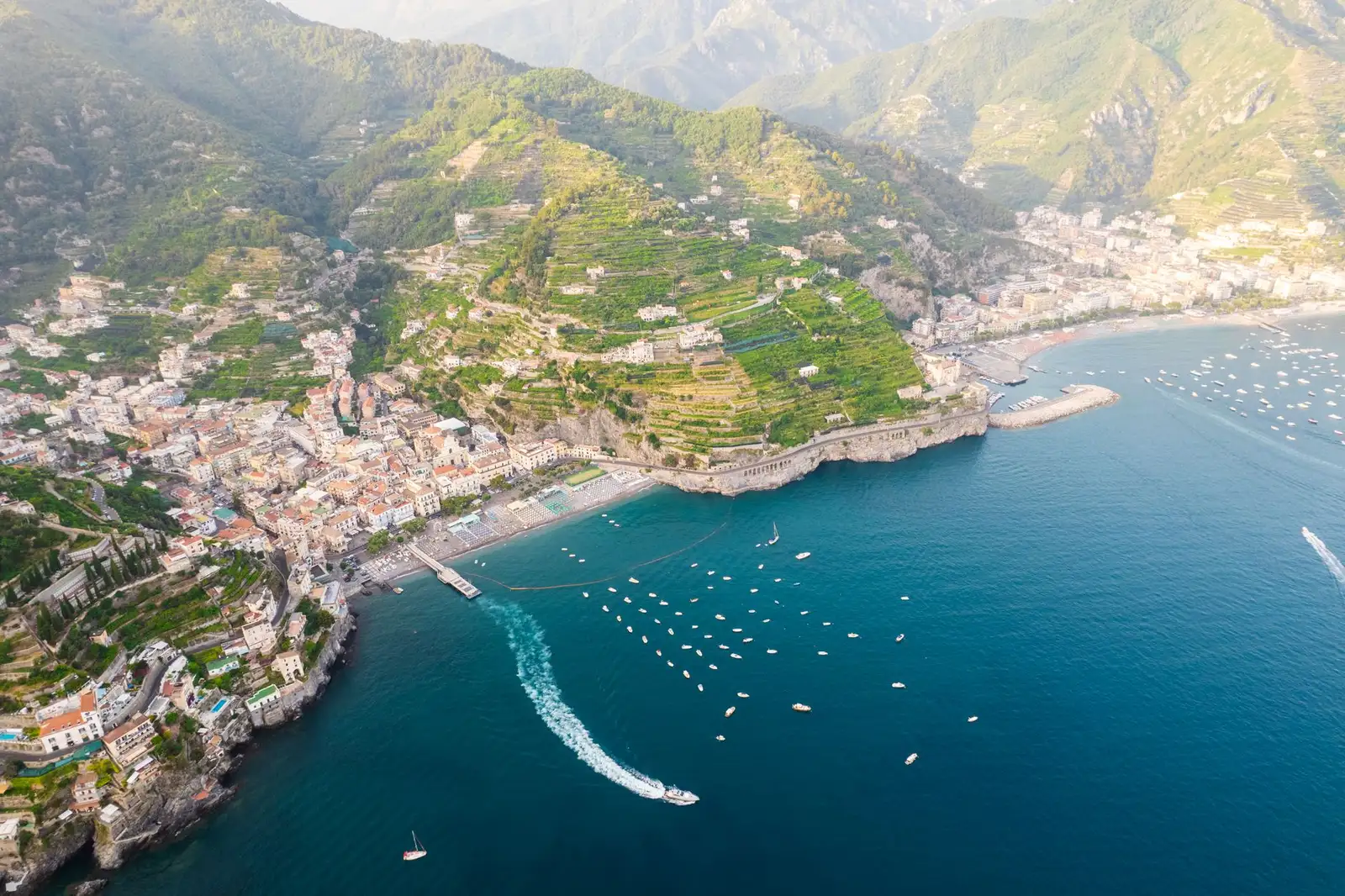

The boat cuts its engine about two hundred meters from Li Galli, and for a moment there's nothing but the slap of water against limestone and the low hum of cicadas carrying across the strait from Positano. The three islets sit there, half-submerged and jagged, doing nothing in particular. And yet Homer put sirens here. Sailors, supposedly, heard something in these rocks that made them forget which way was home.
That's the thing about the Amalfi Coast: it's been asking people to believe impossible things for close to three thousand years, and mostly, they've obliged.
This route follows that persuasion from its oldest form (myth, sung before it was written) through its most recent (a coastline that shows up in fashion campaigns and film montages so often it's practically a genre unto itself). It runs roughly fifty-five kilometers of coastal road between Sorrento and Vietri sul Mare, though the actual distance covered, if you count switchbacks, staircases, and the boat legs, is considerably more forgiving to the odometer than to the inner ear. Four to five days is a sane pace. Fewer than three and you're just collecting photographs of cliffs.
Why This Route Works
Most Amalfi Coast itineraries treat the towns as interchangeable stops on a scenic drive, which misses something important: this coastline has a narrative arc, and the towns fall along it in a specific order for reasons that have nothing to do with convenience. Sorrento sits at the gateway because it always has, a Roman-era resort town that eased wealthy visitors from Naples into the wilder coast beyond without shocking them too badly. From there, the road (built only in the 1850s, which is worth remembering when the hairpin turns start to feel ancient) delivers you into myth first, glamour second, history third, and finally into the elevated, literary quiet of Ravello. That's not a random sequence. It's roughly the order in which the coast built its own reputation.
The geographic logic reinforces the cultural one. As you move southeast from Sorrento, the cliffs get taller and the towns get smaller and more vertical, stacked into gorges rather than spread along beaches. Positano's fame as a bohemian retreat and Ravello's fame as a place for composers and exiled aristocrats aren't separable from their physical positions: one clings to the sea at a dramatic, photographable angle, the other sits four hundred meters up, removed enough to think in. You feel the difference in your legs before you understand it intellectually.
There's also a rhythm question, and this is where a lot of self-guided Amalfi trips go wrong. Positano is loud, dense, and expensive in every sense, including attention. Put Amalfi town or Ravello directly after it and the contrast reads as anticlimax. Put a quieter stop like Praiano between them, and the descent into history at Amalfi lands with more weight. Sequencing isn't decoration here. It's the whole reason the route holds together instead of just being seven pretty places visited in whatever order the map suggests.
Sorrento: The Threshold
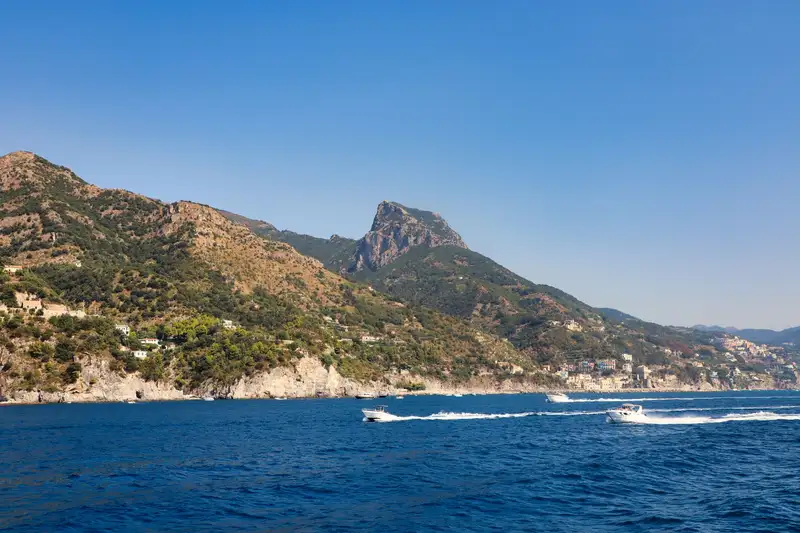
Sorrento isn't technically part of the Amalfi Coast (it faces the Bay of Naples, not the Tyrrhenian side of the Sorrentine Peninsula), but almost every version of this journey starts here, and there's a reason beyond logistics. Roman aristocrats used Sorrento as their staging point before venturing further along the coast, and the town has kept that threshold character for two thousand years: comfortable, slightly self-satisfied, a place to acclimate before things get dramatic.
It's also the last stop where the coast road hasn't started narrowing yet. Stand on the Sorrento cliffs looking south and you can already see the peninsula's mountains rising, but you haven't committed to them. That anticipation matters more than people give it credit for.
Li Galli: Where the Myth Lives
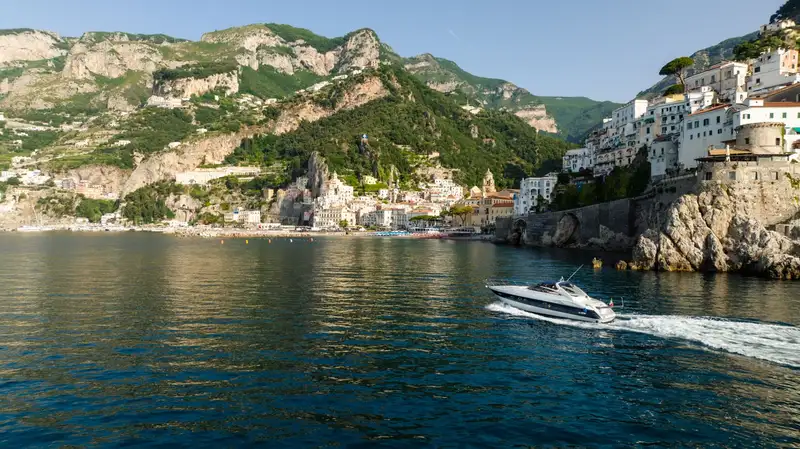
The three islets of Li Galli sit in the strait between Positano and Capri, and according to a tradition that stretches back to Homer's Odyssey, this is where the sirens sang to Odysseus's crew. The Britannica entry on the sirens lays out the mythological framework clearly enough: half-woman, half-bird creatures whose song lured sailors to wreck their ships on the rocks, and whom Odysseus survived only by having his men bind him to the mast while they rowed past with wax in their ears.
Whether Homer meant these islands specifically is genuinely uncertain (the geography in the Odyssey is notoriously slippery), but local tradition has claimed them for centuries, and Rudolf Nureyev owned the largest islet for years, drawn, presumably, by the same theatrical pull that got the sirens their reputation in the first place. You can't land here on most visits. You circle it by boat, which, honestly, might be the right way to experience a myth about the danger of getting too close.
What changes here: this is the only stop on the route that exists purely as story. No town, no residents, no economy beyond the boat operators who circle it. Everything after this point is myth made physical, myth that eventually got buildings and hotel bars.
Positano: Glamour Learns to Perform
Positano is where the Amalfi Coast figured out how to sell itself, and it did so almost by accident. John Steinbeck's 1953 essay for Harper's Bazaar, in which he described the town as "a dream place that isn't quite real when you are there and becomes beautifully real after you have gone," is often credited with launching Positano's postwar tourism boom, and it's not hard to see why the line stuck. The town is built almost vertically into a ravine, houses in pastel stacks tumbling toward a single black-sand beach, and it photographs like nowhere else on the coast.
That photogenic quality has made Positano the coast's default cinematic shorthand: whenever a film or a fashion shoot needs "Italian coastline, glamorous," this is usually the town that shows up. The effect compounds. Fame attracts more fame, which attracts more visitors, which raises prices, which somehow makes the whole thing feel more exclusive rather than less. It's a strange loop, and Positano rides it well.
What changes here: you go from myth (Li Galli, empty and silent) to spectacle (Positano, loud and curated) in the space of a short boat ride. The contrast is the point. One is a story about danger, the other a story about desire, and the coast has been trading on both for millennia.
Praiano: The Breath Between
Most Amalfi Coast guides skip Praiano entirely, which is exactly why it belongs on this route. It sits between Positano and Amalfi town, quieter than both, with none of the boutique density and a coastline that still feels lived-in rather than staged. Fishermen still work out of the small harbor at Marina di Praia. There's no Steinbeck essay attached to it.
That absence of drama is the function it serves. After Positano's intensity, Praiano gives you somewhere to reset before Amalfi's history asks for a different kind of attention. Without this pause, the route would feel like one long crescendo, and crescendos without rests just become noise.
Amalfi: The Republic Before the Postcard
Long before it was a postcard, Amalfi was a maritime power. Between roughly the 9th and 11th centuries, the Amalfi Republic ran trade routes across the Mediterranean, and its maritime code, the Tavole Amalfitane, is still cited as one of the oldest surviving legal frameworks of its kind. The town was also, notably, one of the first places in Italy where pasta was manufactured and sold commercially, a detail that tends to surprise people who think of pasta as a purely southern-Italian invention with no single point of origin.
The Duomo di Sant'Andrea, with its striped Arab-Norman facade rising above a long staircase in the town's main piazza, is the clearest physical remainder of that trading-empire wealth: the design borrows visibly from the Islamic and Byzantine worlds Amalfi traded with, not from anywhere purely Italian. The UNESCO listing for the Amalfi Coast frames this exact point, that the coast's value lies as much in centuries of human adaptation to a difficult terrain as in the scenery itself. You can read more on the UNESCO World Heritage page for the Amalfi Coast.
There's also the limoncello, which deserves its own footnote. The bright, sweet-sour digestive that closes out nearly every meal on this coast isn't tourist theater, it's a genuinely local habit, tied to the lemon groves that terrace the hills behind these towns. Staying in a villa above Amalfi and Atrani (something I've done for years running cooking weeks along this stretch of coast) gives you a completely different angle on it: watching local fishermen pull up overnight traps in small outboards while a twenty-million-dollar superyacht idles fifty meters behind them. Same water, wildly different relationships to it. That contrast is the Amalfi Coast in miniature.
What changes here: Amalfi shifts the register from spectacle to substance. You're no longer just looking at a beautiful coastline, you're standing in the remains of an actual medieval power, and the town's slightly worn, unpolished feel compared to Positano is the physical evidence of that different kind of history.
For anyone weighing whether to base themselves here versus hopping town to town by SITA bus or private driver, the tradeoffs around accommodation strategy along a coast like this and local transportation logistics are worth thinking through before booking anything. The coast road looks short on a map and behaves very differently in a car during August.
Ravello: Where the Coast Went Quiet and Got Famous Anyway
Ravello sits four hundred meters above the sea, removed from the coast road entirely, and that removal is exactly why it became the intellectual and artistic capital of this whole stretch. Richard Wagner reportedly found inspiration for the garden of Klingsor in Parsifal while visiting the grounds of Villa Rufolo in 1880. Gore Vidal lived here for decades, in a villa called La Rondinaia, and wrote about the town's particular quality of quiet with the kind of affection you only get from someone who chose a place deliberately rather than inheriting it.
Ravello has also become a genuine film location in its own right, not just a backdrop implied by association: scenes for the 1954 Humphrey Bogart film Beat the Devil were shot here, and the town has continued to attract productions drawn by the combination of dramatic elevation and relative privacy that Positano, mobbed as it is, simply can't offer anymore.
Its concert season, held partly on a platform cantilevered off the cliffside gardens of Villa Rufolo, turns the whole town's elevation into a kind of instrument. Music carries strangely well off that drop.
What changes here: you leave the coast road behind physically, and the town's whole character depends on that separation. Ravello isn't trying to seduce you the way Positano does. It assumes you've already arrived, and it's mildly uninterested in convincing you further. Some travelers find that cold. I think it's the most honest moment on the entire route.
Vietri sul Mare: The Coast Signs Off
Vietri sul Mare marks the eastern edge of the Amalfi Coast proper, right where the road meets Salerno and the character of the coastline dissolves into a working port city. It's known for ceramics, hand-painted majolica in the deep blues and yellows that show up decoratively across half the coast's hotels and restaurants, and the tradition here goes back centuries, tied to local clay deposits and a trade history that predates the coast's tourism entirely.
Ending here rather than in Amalfi or Ravello does something specific: it lets the route close on craft and daily life rather than on the last dramatic view. After sirens, film sets, and elevated villas, Vietri brings the whole thing back down to something you can hold in your hands and carry home in a suitcase, which feels, after four days of myth and spectacle, like the right kind of ending.
Getting the Sequence Right
The mistake most self-planned trips make is treating this coast as a menu rather than a path, picking the "best" three towns and skipping the connective tissue. But Praiano's calm only means something because Positano came first, and Ravello's remove only registers if you've spent two days at sea level getting increasingly saturated with view after view after view. Anyone deciding between renting a car, hiring a driver, or relying on the SITA bus network should look closely at the actual road conditions before committing (the coast road narrows to a single functional lane in places, and August traffic can turn a forty-minute drive into two hours). A structured framework for choosing between DIY and guided logistics is worth reading before you commit to a rental car you'll regret by day two.
Timing matters as much as sequence. Late May through mid-June, and again in September into early October, give you warm water and manageable crowds without the August crush that turns Positano's single beach road into something closer to a parking lot. Additional planning detail on regional travel patterns is available through Italy's official tourism board, italia.it.
- 1 Sorrento (starting point / cultural threshold)
- 2 Li Galli Islands (mythological site)
- 3 Positano (iconic town)
- 4 Praiano (transitional town)
- 5 Amalfi (historic town)
- 6 Ravello (cultural high point)
- 7 Vietri sul Mare (closing point)
There's no wrong way to see this coast, exactly. But there is a way that lets each stop earn its meaning from the one before it rather than competing with it for your attention, and that's the whole argument for going in this order instead of jumping straight to whichever town shows up most on your phone.
Comments (0)
No comments yet. Be the first!