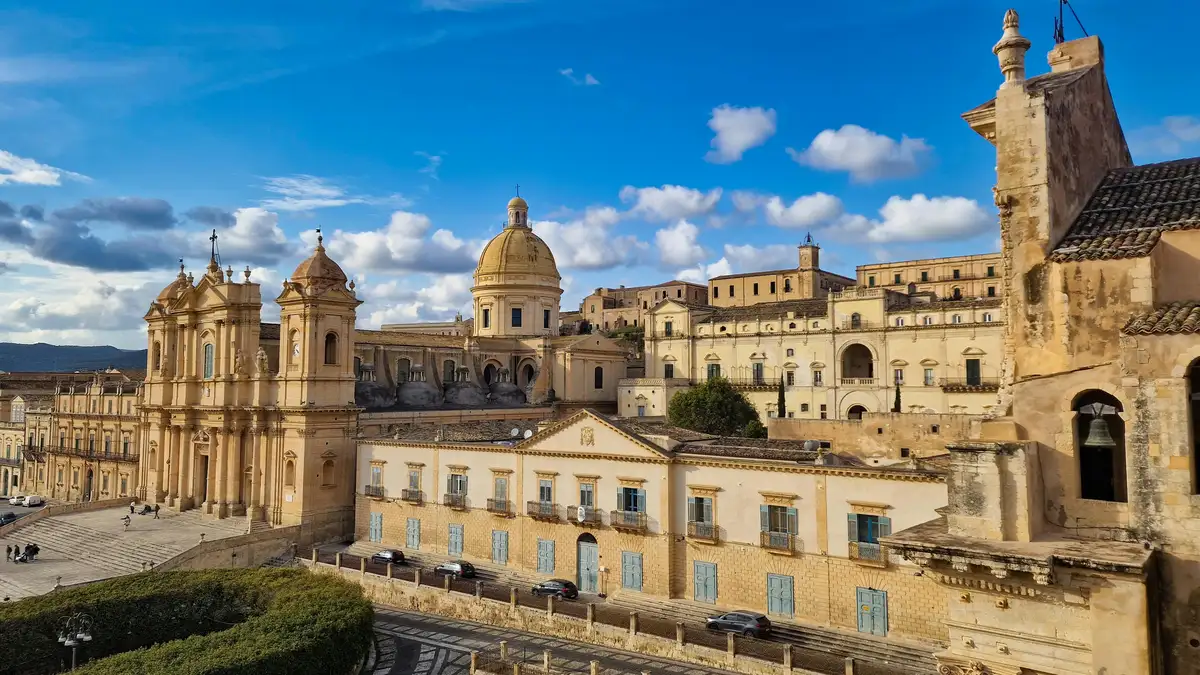
There's a moment in Noto, usually around 6pm when the light goes amber and sideways, where you stop walking and just stare. The cathedral facade glows like it's lit from inside. It isn't, of course. That's just the local golden limestone doing what it does best, and it does it better here than almost anywhere on earth.
This route covers the southeastern corner of Sicily, a stretch of towns collectively inscribed as a UNESCO World Heritage Site in 2002. The reason they share that designation isn't just that they're beautiful (though they are, almost unreasonably so). It's that they were all rebuilt at roughly the same moment, after the same catastrophe, with the same ambition to outdo what came before.
What the 1693 Earthquake Made Possible
On January 11, 1693, a magnitude 7.4 earthquake devastated the Val di Noto region. Entire cities collapsed. Thousands died. The destruction was staggering, and what followed was one of the most concentrated bursts of urban reconstruction in European history.
The architects and nobles who rebuilt these towns didn't just reconstruct what was lost. They seized the moment. Spanish Baroque was in full flower across the Mediterranean world, and Sicily, then under Spanish rule, absorbed it with particular intensity. What emerged was something distinct: Sicilian Baroque, heavier on ornament than its Roman counterpart, stranger in its carved faces and grotesque figures, and deeply theatrical in how it staged streets, piazzas, and facades to create maximum dramatic effect.
Worth it to spend a week here. Every single time.
You can approach this route in any order, but starting in Noto and working east toward Syracuse makes geographic sense and builds a satisfying narrative arc, from the most purely Baroque to the most historically layered.
Noto: The Ideal Baroque City
Noto is where you come to understand what the rebuilders were actually trying to do.
The original Noto was destroyed completely in 1693. Rather than rebuild on the same site, the decision was made to start from scratch eight kilometers away on a flat plateau. This gave the architects something rare: a blank slate. The result is a city planned almost as a single unified composition, with Via Corrado Nicolaci running straight through the center and the major monuments arranged along it like scenes in a play.
Start at Piazza del Municipio. The Cathedral of San Nicolò sits at the top of a broad staircase, its twin bell towers framing a facade covered in carved stone that softens and warms as the day progresses. The cathedral collapsed again in 1996 (the dome, poorly restored, gave way), but a major restoration completed in 2007 brought it back, and the interior is now properly magnificent. Across the piazza, Palazzo Ducezio faces the cathedral with a curved portico that's all lightness and confidence, the civic answering the sacred in equal measure.
Walk down Via Nicolaci in spring if you can. Every May, the Infiorata festival covers the entire street in elaborate flower petal carpets, designs that take weeks to plan and hours to lay. It's ephemeral public art on a scale that's hard to appreciate until you're standing in the middle of it.
The side streets of Noto reward wandering. Palazzo Villadorata on Via Nicolaci has six balconies supported by carved figures: horses, lions, cherubs, and creatures that don't quite fit any category. This is the strange, exuberant side of Sicilian Baroque that no textbook quite prepares you for.
Stay at least two nights. One isn't enough.
Modica: Chocolate, Canyons, and Vertical Drama
Modica doesn't look real from a distance. The town climbs two steep ravines, houses stacked on houses, churches perched on ledges, staircases connecting levels that seem physically impossible to have built. It's one of the most visually dramatic urban landscapes in Italy, and it earns that description without any assistance from marketing.
The Cathedral of San Giorgio sits at the top of a monumental external staircase with 250 steps. The facade is the showpiece: a vertical composition of columns, pilasters, and carved stone that rises in tiers against the sky. Gaetano Sinatra designed it in the 1740s, and the fact that it's still standing, still intact, and still regularly used for Mass is remarkable. Climb to the top of the stairs early in the morning before the tour groups arrive, and you'll have the view largely to yourself.
Modica's second major church, San Pietro, anchors the lower town with twelve life-size statues of apostles flanking its staircase. It's less dramatic than San Giorgio but more intimate somehow, the kind of church where you can actually sit and think.
Then there's the chocolate. Modica produces a style of chocolate that predates modern chocolate-making, a method brought to Sicily by the Spanish from Mexico in the 16th century. The cacao is ground cold with sugar and spices, never melted and remixed, which gives it a grainy, crumbling texture completely unlike anything you'd find in a Swiss confectionery. Antica Dolceria Bonajuto on Corso Umberto I has been making it since 1880 and is the most famous producer, though any of the small shops along the corso will serve you well. Try the cinnamon and the vanilla versions back to back. It changes how you think about what chocolate is supposed to be.
Ragusa: Two Towns in One
Ragusa is technically two towns, and the distinction matters.
After 1693, the nobles of Ragusa rebuilt on a new site above the old city. The old city, Ragusa Ibla, was rebuilt in place by those who refused to leave. The result is two separate urban settlements, Ragusa Superiore and Ragusa Ibla, connected by a steep road and a complex system of staircases and linked by the Ponte dei Cappuccini bridge.
Ragusa Ibla is where most visitors want to spend their time, and for good reason. The Duomo di San Giorgio in Ibla (different from Modica's San Giorgio, though also designed by Rosario Gagliardi) dominates a sloping piazza with a facade that curves gently outward, drawing the eye upward through three tiers of columns to an oval dome. Gagliardi, who designed major monuments in both Modica and Noto as well, is the presiding genius of Sicilian Baroque, and this is probably his masterpiece.
Wander the streets of Ibla without a particular plan. The Giardino Ibleo at the eastern end of town offers shade and a view over the valley below. The little church of San Giuseppe, oval in plan and opulent in decoration, sits almost hidden in Piazza Pola. The cooking is exceptional here too (and honestly, that's the whole point of a lot of Sicilian travel): Ragusa province produces some of Sicily's best olive oil and cheeses, and the local restaurants use both without restraint.
Ragusa Superiore is less visited but has its own appeal, particularly the Baroque-era Palazzo Cosentini with its famous carved balconies. Those balconies are famous partly because they appeared extensively in the Italian TV series "Inspector Montalbano," which filmed extensively in the Val di Noto for decades. If you've watched the show, you'll spend half your time in Ragusa saying "that's where Montalbano..." to anyone who'll listen.
Scicli: The Quietest and Most Cinematic
Scicli sits in a valley between three rocky cliffs, each topped with the ruins of abandoned churches and convents. It's quieter than the other towns on this route, less touristed, and because of that it has an almost eerie quality, as if the Baroque stage set has been left standing after the audience went home.
The main street, Via Francesco Mormino Penna, is wide and lined with palaces in various states of grandeur. Palazzo Beneventano, with its carved grotesque faces on the balcony brackets, is the most photographed. Chiesa di San Bartolomeo, built into a cave at the base of the cliff, is the most unusual. The church of Santa Teresa, with its simple but elegant facade, is the most restrained, which in this context counts as a radical statement.
Scicli was used heavily as a filming location for "Inspector Montalbano," particularly the police headquarters scenes. The actual Palazzo Municipale stood in for the fictional Vigata police station for years. This gives parts of Scicli a slightly doubled quality, where you're seeing both the real place and the fictional overlay simultaneously. It's strange and pleasant.
Is Scicli the best stop on this route? That depends entirely on what you want. If you want crowds and cafes and easy tourist infrastructure, probably not. If you want to feel like you've actually found something, yes.
A Note on How to Travel This Route
These towns are close enough that you could theoretically day-trip between them from a single base. Ragusa to Noto is about 55 kilometers, and the roads, while not always fast, are manageable.
That said, staying in at least two or three of these towns rather than racing through them all from one base is worth considering. The character of each place changes completely after the day visitors leave, and the evening passeggiata, that slow, sociable promenade that Sicilians do better than anyone, is one of the genuine pleasures of this region. You won't experience it if you're already driving back to your hotel in another town.
For a good practical breakdown of whether to plan this kind of route independently or through a guided tour, the framework at tripplan.org is genuinely useful. The Val di Noto is very doable independently, but the context provided by a good local guide, especially in places like Noto where the architectural decisions were so specific and deliberate, adds real depth.
Syracuse and Ortigia: Where Baroque Meets Everything Else
Syracuse is the final stop, and it earns its place as the culmination of this route.
The city was founded by Greek colonists from Corinth in 734 BC and was, for several centuries, one of the most powerful cities in the Mediterranean world. It defeated Athenian naval expeditions. It traded with Carthage. It produced Archimedes. The Greeks left behind the Teatro Greco on the Neapolis hill, a theater carved into the rock in the 5th century BC that still hosts classical drama performances each summer, and the Ear of Dionysius, a cave shaped like an ear that amplifies sound with uncanny precision.
But the heart of Syracuse is Ortigia, the small island connected to the mainland by two short bridges, and this is where the route's Baroque thread comes back into focus.
Piazza del Duomo in Ortigia is one of the most satisfying urban spaces in Italy. The Cathedral itself is extraordinary in a specific way: it was built in the 7th century AD by literally encasing a Greek Doric temple, the Temple of Athena, within Christian walls. You can see the original Greek columns incorporated into the cathedral's side walls from the street. The Baroque facade was added in 1754 by Andrea Palma, following earthquake damage, and it frames this extraordinary palimpsest of 2,700 years of continuous sacred use.
The Fountain of Arethusa, just off the piazza, is one of those places where mythology and reality blur in a pleasant way. The freshwater spring here, which flows near the sea, was explained by the ancient Greeks as the transformed body of a nymph who fled from the river god Alpheus by swimming under the Mediterranean from Greece. Papyrus grows around the pool. It's genuinely strange and beautiful.
Ortigia's streets are dense with Baroque architecture: Palazzo Beneventano del Bosco, the church of Santa Lucia alla Badia with its 18th-century facade, the Via della Maestranza lined with noble palaces. But the island is also small enough to walk completely in an afternoon, and it has the energy of a living town rather than an open-air museum. People actually live here, shop here, argue in the street here.
Eating in Ortigia is one of the specific joys of this trip. The morning market near the Fonte Aretusa sells produce, fish, and street food, and the concentration of good restaurants in a small area means you can eat extremely well without much planning. Sicilian cuisine in this part of the island leans heavily on fresh fish, capers from Pantelleria, local almonds and pistachios, and a willingness to combine sweet and savory in ways that still surprise people who think they know Italian food.
Understanding how Sicilians actually eat together, not just what they eat, makes a real difference to how you experience a place like Ortigia. The piece at livedbylocals.com on Italian meal culture is worth reading before you arrive. Knowing that a long, slow lunch is a social act and not an inefficiency changes how you participate in it.
Practical Notes
Getting around: A rental car is almost essential for this route. Public buses connect the major towns but infrequently and not always at convenient times. The roads through the Val di Noto are generally good, though GPS occasionally loses its mind on the approach roads to Ragusa Ibla.
Best time to visit: April through June and September through October. July and August are hot, crowded, and expensive. Winter is quiet and mild, and the towns take on a different character, more local and less performative.
How long: Five to seven days is the sweet spot. Less than five days and you'll feel rushed; more than a week and you might find the architectural intensity starts to blur into itself.
Where to stay: Noto, Ragusa Ibla, and Ortigia all have excellent accommodation options at various price points. Converted noble palaces are common in this region, and staying in one isn't an extravagance, it's part of understanding what the Baroque project was actually for.
What This Route Is Really About
The Val di Noto Baroque route is often framed as an architecture trip, and that's not wrong. But it's also a trip about what happens after catastrophe, about the human instinct to rebuild not just functionally but beautifully, and to use beauty as a form of defiance.
The nobles and architects who designed these towns after 1693 had just watched everything collapse. Their response was to build more ambitiously than before, to carve more faces into more stone, to make staircases that were twice as long as necessary and facades that were twice as ornate as anything the earthquake had destroyed. There's something almost aggressive about the beauty here.
Whether you're an architecture enthusiast or someone who just knows they like beautiful places without always knowing why, southeastern Sicily delivers something that's genuinely hard to find anywhere else: a moment in history made visible in stone, still standing, still warm in the afternoon light.
Comments (0)
No comments yet. Be the first!