Journey Waypoints
Why This Route Works
The Tuscan-Umbrian Corridor succeeds because it’s a progression, not a collection. Each stop changes something fundamental about the experience - the scale shrinks, the pace slows, the crowds thin, and the cultural register shifts from cosmopolitan to regional to local.
Most travelers treat central Italy as a highlight reel. Florence, Siena, maybe a winery, then Rome. This approach produces exhaustion and blur. You’ve seen famous things, but you haven’t experienced a journey with shape and direction.
This route works differently. It uses Florence’s intensity as a starting point, then systematically releases that pressure across 180 kilometers of carefully sequenced stops. By the time you reach Orvieto, you’re in a genuinely different Italy - quieter, stranger, less performed for visitors.
The key insight: what you experience at each stop depends on what came before. Orvieto after Florence feels like arrival. Orvieto as a day trip from Rome feels like a checkbox.
Florence: Establishing the Baseline
Florence is not the destination. It’s the setup.
Spend two or three days here, enough to absorb the density - the Uffizi, the Duomo, the crowds surging across the Ponte Vecchio. Let yourself feel the weight of it. The Renaissance didn’t happen gently. It was competitive, expensive, and exhausting. Florence still carries that energy.
This intensity matters for what comes next. Without experiencing Florence’s cultural pressure, the relief of rural Tuscany won’t register properly. You need the contrast.
The historic center is a UNESCO World Heritage site, and deservedly so. The concentration of Renaissance art and architecture here has no parallel. But that’s precisely why you shouldn’t linger too long. Florence works best as a powerful first impression that makes you ready to leave.
Stay in the Oltrarno if you can - the south bank, across from the tourist core. The artisan workshops there still function. You’ll hear hammering from gilders and smell leather from the remaining craftsmen. It’s not pristine, which is the point.
Practical note: book your Uffizi tickets months ahead, or don’t bother. The reservation system exists because the alternative is three-hour lines. The Galleria dell’Accademia (for the David) requires the same planning. Everything else in Florence can be approached more spontaneously.
The Drive to Siena: First Transition
The 70 kilometers from Florence to Siena take about an hour on the superstrada, but that’s not how to do this.
Take the old road through Chianti instead. The SS222, the Chiantigiana, winds through the wine hills between the two cities. It adds time but changes the nature of the transition. You’ll pass through Greve, Panzano, Castellina - small towns that exist for wine production, not tourism, though they’ve learned to accommodate visitors.
This is where Tuscany starts becoming the postcard version of itself. Cypress rows, stone farmhouses, vineyards running to the horizon. The landscape has been shaped by centuries of wine cultivation, and it shows.
Stop in Greve for lunch. The central piazza has an unusual triangular shape, designed for the weekly market that still happens here. The butcher shops (macellerie) sell wild boar products - salami, prosciutto - that taste different from commercial versions. This is where you start noticing regional ingredients.
The Chianti passage serves a purpose beyond scenery. It establishes that Tuscany between cities is not empty space to cross. It’s inhabited, cultivated, and culturally specific. This realization prepares you for what Umbria will offer later.
Siena: The First Decompression
Siena is not Florence with smaller crowds. It’s a different city with a different history and a different relationship to its past.
Where Florence embraced the Renaissance and became cosmopolitan, Siena froze in the 14th century. The Black Death devastated the city in 1348, killing perhaps two-thirds of the population. The Sienese never fully recovered economically, which paradoxically preserved their medieval city intact. What looks like heritage preservation was actually economic stagnation.
This history matters for the traveler. Siena’s historic center feels suspended in time in ways that Florence does not. The Gothic architecture remained dominant. The campo - the shell-shaped central piazza - maintained its medieval dimensions. The contrade (neighborhood districts) still organize social life.
Walk the campo in the evening, when the day-trippers have bussed back to Florence. The piazza tilts toward the Palazzo Pubblico like a natural amphitheater. Sienese families occupy the cafe tables. Teenagers congregate near the fountain. The Palio horse race happens here twice each summer, but the campo functions year-round as the city’s living room.
The duomo deserves attention, particularly the floor - an extraordinary marble mosaic that’s only fully uncovered for a few weeks each year. The Piccolomini Library inside contains Pinturicchio frescoes that rival anything in Florence but without the queues.
Two nights in Siena works well. One full day for the city, evenings in the campo, enough time for the rhythm to register.
The Val d’Orcia: Landscape as Protagonist
Between Siena and Montepulciano lies the Val d’Orcia, a landscape so distinctive it has its own UNESCO designation.
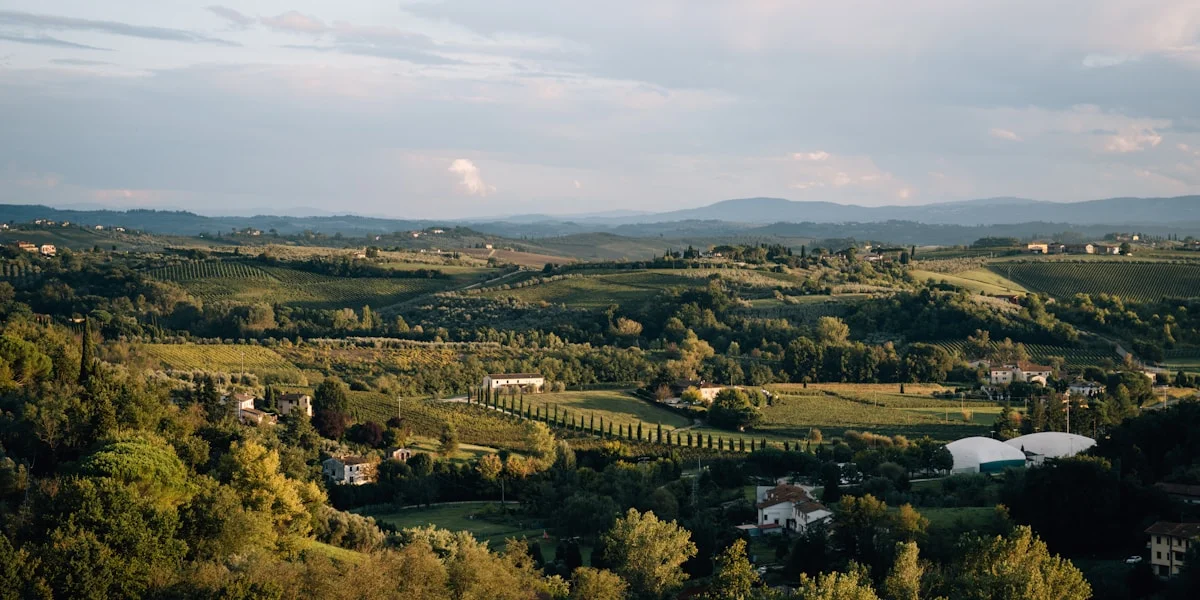
This is where central Italy stops resembling anywhere else. The hills roll in soft curves. Cypress trees appear in deliberate rows, planted centuries ago to mark property lines and provide wind shelter. The light changes across the day in ways that explain why Renaissance painters were obsessed with landscape.
The Val d’Orcia contains several small towns - Pienza, Montalcino, San Quirico d’Orcia - but the landscape itself is the attraction. This is a place to drive slowly, stop frequently, and watch how shadows move across wheat fields.
Pienza deserves a pause. Pope Pius II rebuilt his hometown in the 15th century as an ideal Renaissance city, a philosophical experiment in urban planning. The result is tiny - you can walk the entire historic center in fifteen minutes - but conceptually significant. This is what happens when someone tries to design a perfect town from scratch.
The pecorino cheese from Pienza is exceptional, aged in various ways that produce distinct flavors. Buy some in the shops near the duomo. It’s meant to be eaten with Montalcino’s Brunello wine, and this is where the two products originate within kilometers of each other.
Montalcino itself sits on a higher hill, visible from miles away. The fortress at the summit offers views across the entire Val d’Orcia. More importantly, the wine shops here offer tastings of Brunello at various price points. This is not casual wine tourism - Brunello is serious, expensive, and requires attention. But tasting it here, where the grapes grow on visible hillsides, changes your relationship to it.
Montepulciano: The Transition Point
Montepulciano marks where Tuscany begins yielding to Umbria.
The town perches on a limestone ridge at 600 meters elevation, higher than the surrounding landscape. From the main piazza at the top, you can see in all directions - the Val d’Orcia behind you, Lake Trasimeno ahead, the first hints of Umbrian hills beyond.
This is Renaissance architecture again, but different from Florence. The noble families here built summer palaces to escape the urban heat, and their architects experimented with forms that wouldn’t fit in crowded city streets. The result feels more spacious, more confident, less compressed.
Montepulciano’s reputation rests on Vino Nobile, a red wine made primarily from Sangiovese grapes grown on these slopes. The cellars run beneath the town in the soft tufa rock, maintaining constant temperature year-round. Several offer tastings and tours, and walking through centuries-old barrel rooms provides context that wine shops cannot.
The Sangiovese here tastes different from Chianti or Brunello, despite sharing grape parentage. Local winemakers attribute this to the soil, the elevation, the specific microclimate. Whether or not you accept terroir as an explanation, the differences are real and noticeable.
Stay one or two nights. Montepulciano empties dramatically after sunset when day-trippers depart. The restaurants that serve residents rather than tourists become visible. The passeggiata - evening stroll - reveals how small the local population actually is.
Crossing into Umbria: What Changes
The border between Tuscany and Umbria is administrative, not physical. No signs announce the transition. The landscape continues in similar patterns - hills, olive groves, vineyards.
But something shifts. The tourism infrastructure thins. The souvenir shops become less frequent. The English menus appear less often. Umbria receives a fraction of Tuscany’s visitors, despite comparable landscapes and superior food.
This differential exists because Umbria lacks Florence. There’s no single iconic city pulling international attention. Perugia and Assisi draw visitors, but neither dominates the collective imagination the way Florence does. The result is a region that feels less performed, less arranged for outside consumption.
The food changes too. Umbria is landlocked and mountainous, historically poor in the ways that produce excellent peasant cooking. Black truffles from Norcia, lentils from Castelluccio, wild boar prepared in ways that differ from Tuscan preparations. The olive oil tastes sharper, more peppery, from different cultivars grown at different elevations.
These changes accumulate gradually. By the time you reach Orvieto, you’re in demonstrably different territory - culturally, gastronomically, visually. The transition happened without obvious markers, which makes it feel like discovery rather than tourism.
Orvieto: The Arrival
Orvieto appears suddenly. The town sits on a volcanic plateau that rises straight from the valley floor, visible for kilometers before you arrive. This dramatic geology is not Tuscan. It’s Etruscan - a reminder that this region had a completely different civilization before Rome.
The duomo dominates the town’s skyline, its Gothic facade covered in gold mosaics that catch afternoon light. Inside, Luca Signorelli’s Last Judgment frescoes in the San Brizio Chapel prefigure Michelangelo’s Sistine ceiling by several decades. Art historians consider these paintings pivotal in the development of Renaissance figure painting.
But Orvieto’s real revelation is underground. The plateau is honeycombed with caves, wells, and tunnels carved over three thousand years of continuous habitation. The Etruscan sections date to the 6th century BCE. Medieval sections include colombaie (pigeon houses) that provided both food and fertilizer. Renaissance nobles dug their own cellars for wine storage.
Tours of Orvieto Underground run several times daily and last about an hour. They’re worth the time. Seeing how inhabitants across millennia modified the same volcanic rock provides a vertical history that above-ground architecture cannot offer.
The town works as a terminus because it delivers something distinctly different from Florence. Orvieto is quieter, stranger, less tourist-oriented, and connected to a deeper past. If you’ve moved through the corridor correctly, arriving here feels like discovery - not just another stop, but a destination that rewards everything that came before.
Practical Considerations
Car rental: Essential for this route. Pick up in Florence, drop off in Orvieto. One-way fees apply but are worth paying. Attempting this by public transport is technically possible but eliminates the spontaneous stops that give the route meaning.
Driving notes: Italian speed cameras are aggressive and efficient. Tickets arrive months later at your home address. The ZTL (limited traffic zones) in historic centers catch many tourists. Orvieto’s funicular from the lower parking lot to the town center avoids driving into the restricted area.
Accommodation rhythm: Two nights Florence, two nights Siena, one night Val d’Orcia (Pienza or Montepulciano), two nights Orvieto. Adjust based on your pace and interests, but resist the temptation to move faster. This route works through accumulation, not collection.
When to go: May and September offer the best balance of weather, crowds, and prices. August is problematic - Italians vacation domestically, prices peak, and some restaurants close as owners take their own holidays. Winter is possible but reduces the landscape experience significantly.
Budget note: This corridor is not cheap. Tuscany and Umbria charge premium prices for accommodation and food. Plan accordingly, or accept simpler lodging. Agriturismos (farm stays) often provide better value than hotels while connecting you more directly to the rural economy.
The route works because each stop serves a purpose in the sequence. Florence provides intensity that makes decompression meaningful. Siena offers the first release of pressure. The Val d’Orcia demonstrates that landscape can be a destination. Montepulciano marks the transition. And Orvieto provides arrival - a place genuinely different from where you began, earned through the journey that brought you there.